


It has been a while since a professional development session has left me feeling so empowered, buzzing with adrenaline and ready to implement new strategies with children and share information with staff and families. I recently took part in the ‘Dyslexia and Hidden Disabilities’ online training that I had booked into last year, and it was AMAZING! Sharon Boyce really opened my eyes to the many ways dyslexia can present, the frustration that you feel and more ways I can support inclusion.
I have always had a passion for supporting children to find the mode of communication that works best for them. My first introduction to dyslexia was when one of my friends in year three turned up to school wearing rose coloured glasses but it wasn’t until my now adult nephew was in primary school that I began to understand dyslexia more. It was clear from the get go that my nephew was a visual learner, a fabulous artist always drawing, designing and building things, he was also great at sports always advancing by visually studying and copying techniques. It wasn’t until he came home with sight words that we began to notice his struggles. He had always been a great story teller and loved to listen to stories and watch movies, but when it came to reading it was a chore and he tired very quickly not wanting to continue. His teacher had created his sight words on different colour/sizes of cardboard and we quickly realised that this clever kid had worked out a way to memorise the sight words by the shape and colour of the card, not the letter/word formations. For him the letters never seemed to stay in the same place and the same word looked different every time he read it.
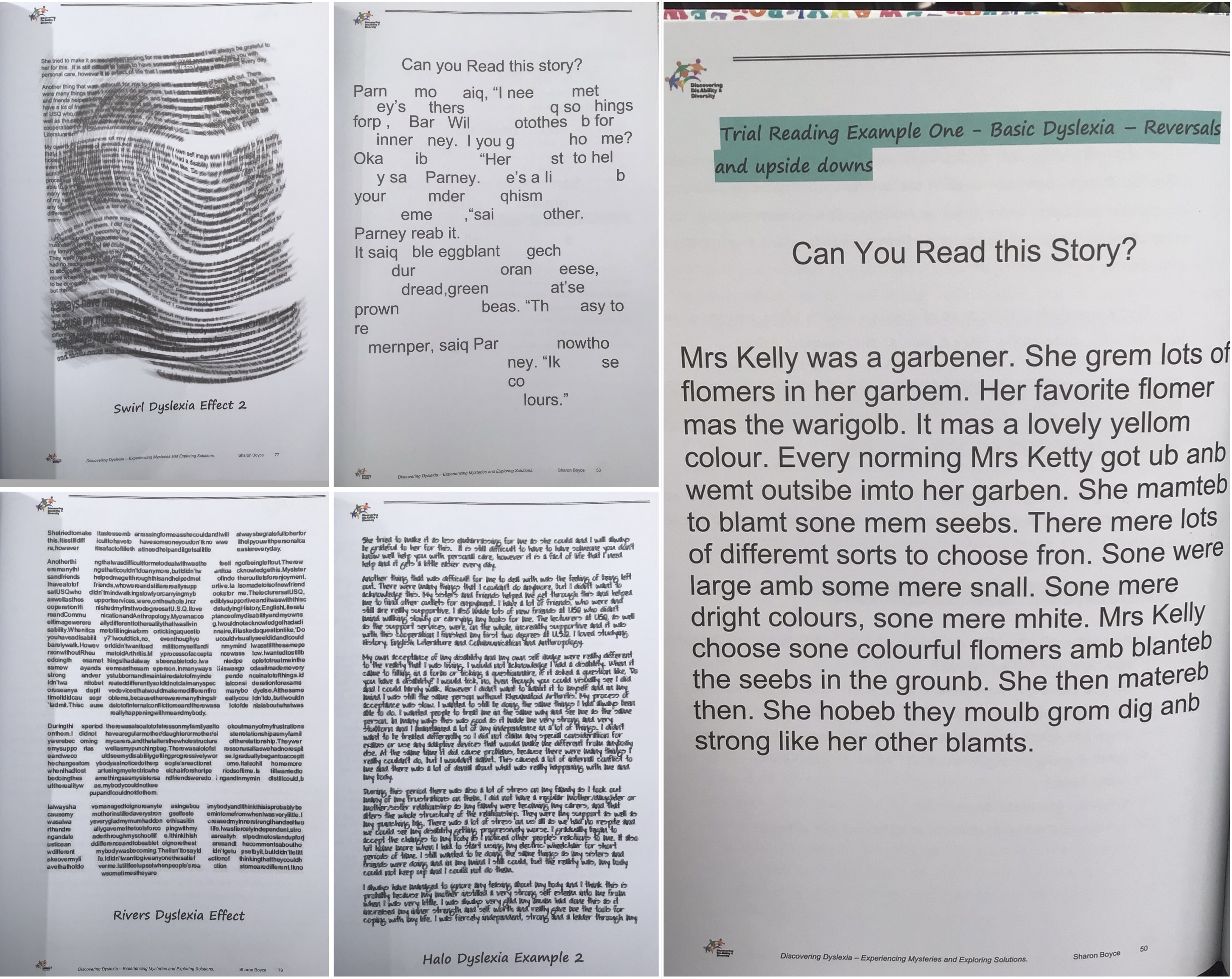
Dyslexia is not a problem with your eyes or a problem with your brain, it is more to do with the speed at which the eyes can transfer information back to the brain and how well the left and right brains work together, well the communication between all components of the brain really. Dyslexia presents in many different ways and can involve just letters or numerals or both letters and numerals. Letters and numerals can seem reversed, appear front to back, upside down, jumping, moving and jumbling. Text can track on different lines, like seesaws where the writing flows up and down, in swirling formations and with halos. Visual rivers can present in text and it can seem blurred or even washed out. I was exhausted just trying to read some of the examples and can’t begin to imagine how tiring and frustrating it would be to view text like this every single day, I have included a collage of some visual examples from Sharon’s book ‘Discovering Dyslexia - Experiencing Mysteries, Exploring Solutions’ (2019). Even when some of these examples were displayed in the staff room, many educators struggled to read them, it was only when the pattern was highlighted to them they could understand the whole piece. If we can discover the way a child is communicating with us then we can empower them with the support strategies and technologies to enable clearer messages between their eyes and brain (and vice versa).
Dyslexia has always been a difficult learning challenge to identify early and there is no quick fix for dyslexia. What we do have however, is knowledge. Access to a range of strategies to explore in hope of finding the best way for each child to develop their own strengths for learning and communicating. This is exactly what my nephew did. With the help of his teachers and his family advocating for a strength based learning approach, he was able to access audio text books, combine his maths learning with his woodwork and art and now he is studying architecture at one of Australia’s most prestigious universities.
We live in a world now where we have access to a multitude of fonts, where spacing can be determined by the author/ teacher/ parent, where illustrations can support text, audio books can support reading, text dictation can support writing and there is a spectrum of colours to suit the contrast needs for each child as they learn to negotiate negative space. It would seem though that the most important element, yet most lost element amongst it all is TIME. Children (and adults) show so much more potential when pressure is non existent and time constraints are thrown out the window. Even adults that have developed strategies to successfully manage their dyslexia will revert back in moments of stress and pressure, so imagine what a rushed feeling to perform, understand or create does to our children. NAPLAN is a prime example of this.
As families it is so important to share knowledge with your child’s educator because dyslexia can have genetic links or key markers (like not crawling before walking) that can be supported with early intervention. This is why at Margaret Ives we implement cross body movement patterns in our daily preschool routines and explore the ‘move to learn’ program, so we can get the messages moving across the hemispheres of the brain. We also include phonemic awareness strategies in our morning meeting, group times and play so we can determine if children are having difficulty with letters, letter sounds, numbers, rhyming and repetitive songs. We also encourage the children to read to us, by simply looking at the pictures and telling us a story, or performing and creating. We don’t want them to fear reading, we want them to embrace themselves as storytellers and develop a love for communicating. Most importantly we provide multiple resources and experiences for children to explore and discover more about themselves as a learner and communicator in play.
I think by far the most beneficial thing I learned from this training and the one thing I have wondered about for so long was… how I can support families to find a service that can explore this developmental area and one that doesn’t cost a fortune. Well, it turns out that Medicare offers access to one free optometrist check! Have you ever heard of a ‘Behavioural Optometrist?’ (neither had I) but if you ask your local optometrist if they are a Behavioural Optometrist or look one up, they can explore vision and visual messaging as opposed to just eyesight and it still comes under the free Medicare visit. Whilst they do not diagnose or treat dyslexia, they provide comprehensive testing for a range problems with eyes and visual processing, that could set you on a path of discovery.
Knowledge is power and I hope you all feel more empowered with what I have shared from my own learning experience. We are all here to support your child and if any of you are interested in viewing Sharon's book please come and ask to borrow it.
Ollie Lauder
MICCC PRESCHOOL TEACHER